

Benevolence, Priced In
The Ebola Outbreak: The US Won't Help. And Now China Won't Either.
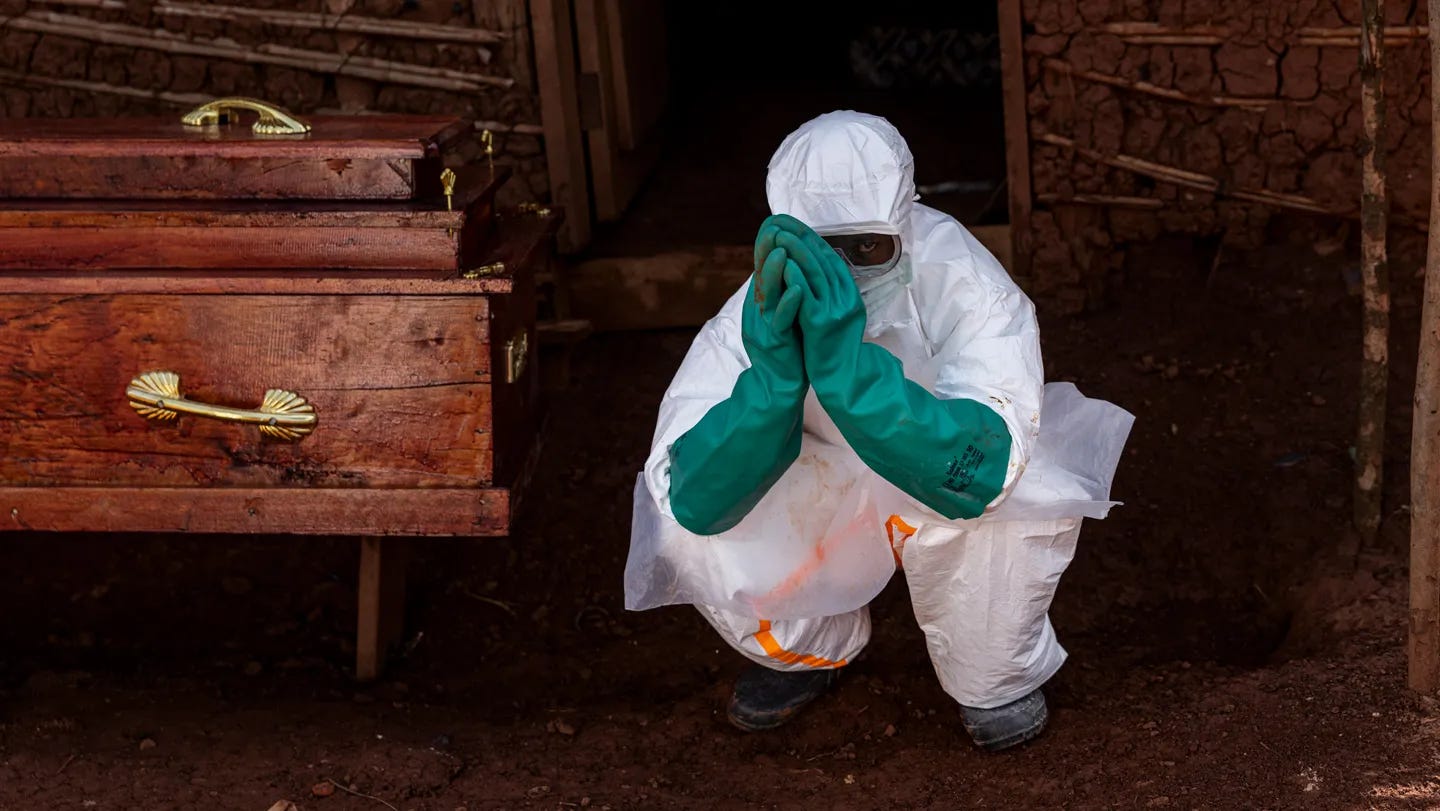
There is a town in northeastern Congo called Mongbwalu, built on gold, where men have died for the contents of the earth since before the Belgians arrived to perfect the practice. It is now dying for a different reason. The Bundibugyo strain of Ebola — a virus with no licensed vaccine, no approved treatment, and no rapid test — has settled into Ituri Province, a region already governed less by the government than by the militias that tax its mines. By early June, the Congolese health ministry counted 381 confirmed cases and 64 deaths, with Uganda adding a smaller tally across the border. In a region with almost no testing, those numbers are really just a guess, and the guess only climbs. The World Health Organization (WHO) declared a Public Health Emergency of International Concern on May 17. The question that followed was the interesting one, and it was not medical. It was: who, this time, comes running to help?
For seventy years the answer was reflexive. Washington ran. The United States built the architecture of global health response the way the British once built lighthouses — because the hegemon that runs the world insures the trade routes it profits from (not from decency). That reflex is gone. In 2025 the Trump administration took what one health official memorably called a chainsaw to the apparatus, dismantling USAID and terminating roughly 80% of its global-health awards, some $12.7 billion in unobligated funding left to evaporate. On January 22, 2026, the country formally completed its exit from the WHO, declining even to settle its debts, a gesture with all the dignity of skipping out on the dinner check at a restaurant you co-founded. The Lancet has modeled the consequences and arrived at a shocking number: up to 14.1 million additional deaths by 2030 if the cuts hold. Aid workers on the Congolese border have been blunter: this outbreak was crippled before the first patient ever tested positive.
So a hole opens, and something is supposed to rush in to fill it. The obvious candidate is China, which possesses everything the moment seems to demand: the world’s largest manufacturing base, a biotechnology sector now at the frontier, a deep commercial entanglement with Africa, and a recent and unwanted education in epidemics. More to the point, China has done this before, and done it impressively. During the 2014–2016 West African catastrophe, Beijing mounted the largest humanitarian operation in its history — north of $120 million across four tranches, some 1,200 medical and disease-control personnel dispatched to Guinea, Liberia and Sierra Leone, and the first Chinese biosafety laboratory ever built on foreign soil. Beijing announced its first wave of aid a single day after the WHO sounded the global alarm. It was, by any measure, a debut on the world stage, and the staging was deliberate. Why is China no longer helping?
Keep reading with a 7-day free trial
Subscribe to Passing the Torch Newsletter to keep reading this post and get 7 days of free access to the full post archives.