

Chevron in Iraq
The irony of physical infrastructure being ever-so important in the AI moment.
For the better part of a decade, the dominant story about the economy has been a story about dematerialization. Money became a ledger entry, assets became tokens, office spaces became a video call, registers became a checkout button, art became a JPEG with a serial number, and the smartest capital in the world spent its time betting on the layer of abstraction sitting furthest from anything you could drop on your foot. The implicit promise was that atoms were legacy and bits were the future — that the interesting margins, and the interesting money, had migrated up the stack, away from the messy business of moving things and making things.
Then, in the spring of 2026, a stretch of water between Iran and Oman roughly as wide as the length of a few football fields reminded the entire global economy that the bits still flow at a price set by the atoms.
The Strait of Hormuz is the single most important oil transit point on the planet. In a normal quarter, something on the order of a fifth of the world’s seaborne crude and roughly a third of its liquefied natural gas squeeze through a channel whose shipping lanes are only a couple of miles wide in each direction. There is no meaningful way to route around it. That was always the theoretical vulnerability. In 2026 it stopped being theoretical.
After the U.S.–Israeli air campaign against Iran opened at the end of February, Iran declared the strait closed and made the declaration credible the hard way — mining the channel, boarding merchant ships, and putting missiles into tankers. Traffic collapsed. Iraq, which routes the overwhelming majority of its exports through the Gulf, watched its oil shipments fall from more than four million barrels a day in February to well under two million by late spring. A June ceasefire briefly cracked the strait back open; by July it had collapsed, and Iranian cruise missiles were again striking supertankers in Omani waters while Brent pushed back toward the mid-$80s. Analysts began quietly circulating a much more uncomfortable thesis than “temporary spike”: that even after a settlement, Hormuz traffic may never fully return, because shipowners will now permanently price in the possibility that the lane closes again without warning — the same way Red Sea traffic never recovered after the Houthi campaign.
We are in the most digitized, tokenized, financially sophisticated global economy in human history. Oil is traded as a paper claim thousands of times over before a single barrel physically moves. And none of that abstraction did a thing. You cannot tokenize your way past a mined shipping lane. You cannot settle a barrel that is stranded in the Gulf. When the physical layer breaks, every clever layer stacked on top of it discovers it was only ever borrowing the physical layer’s permission to exist.
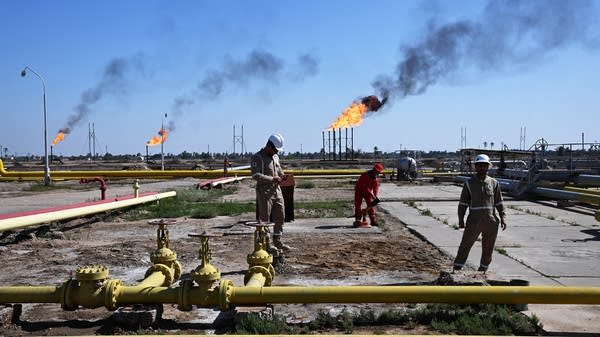
This week in Washington, against the backdrop of a U.S.–Iraq business summit where the two governments are lining up tens of billions in commercial agreements, Chevron is signing a set of accords with Baghdad. The headline items are the southern fields — West Qurna-2 and Nasiriyah — where Chevron is stepping into positions vacated by sanctioned Russian operators. But the more interesting item: Chevron is joining a consortium studying the revival of a pipeline to get Iraqi crude out of the country without touching the Gulf at all.
The route under study is the old Kirkuk–Baniyas line — roughly 500 miles of steel that once carried crude from the fields of northern Iraq across Syria to the Mediterranean coast, and that has sat mostly dead since it was wrecked during the 2003 invasion. The proposed answer to the most modern possible problem — a digitized, financialized global energy market held hostage by a single chokepoint — turns out to be almost aggressively unmodern. It is not an app. It is not a clever derivative that hedges Hormuz exposure. It is rebuilding a physical artery across a desert that has been out of service for two decades, so that atoms can reach the sea by a different road.
When the physical world imposes a constraint, the binding solution is almost always more physical infrastructure — more pipe, more port, more route, more optionality measured in geography rather than in code. The financial layer can price the constraint. Only the physical layer can relieve it.
The mistake embedded in the dematerialization story was treating “digital” as a substitute for physical infrastructure rather than a layer built on top of it.
Tokenization is a genuinely powerful idea. Turning a barrel, a building, a bond, or a megawatt-hour into a programmable claim changes who can own it, how fast it settles, how finely it can be sliced, and how cheaply it can be traded. Those are real efficiencies and they are not going away. But notice what tokenization does not do: it does not move the barrel. It does not pour the concrete. It does not lay the fiber, energize the substation, dredge the harbor, or weld the pipe. It rearranges the claims on physical stuff at the speed of software while leaving the physical stuff exactly as heavy, as slow, and as geographically stubborn as it has always been.
Every digital abstraction bottoms out in something you can trip over. The cloud is a warehouse full of hot metal drinking enormous quantities of electricity and water. The “online economy” is fiber in the ground and ships full of goods and trucks on interstates. A stablecoin is a database entry whose credibility depends entirely on hard, boring, physical reserves. Strip away the interface and every one of these is a claim on atoms and when the atoms get scarce or get stuck, the claim is what gets repriced, violently, in real time. Hormuz was just the most literal possible demonstration: the paper market convulsed precisely because the physical market could not deliver.
The tempting counterargument is that this is the old economy’s last stand — that as capital rotates into artificial intelligence, we are finally building something that lives in pure information and needs less of the physical world, not more.
The opposite is true, and it is not close.
The AI buildout is the most physically demanding capital cycle in a generation. It is a story about atoms wearing a software costume. Training and serving frontier models requires data centers, and data centers require staggering quantities of the least glamorous inputs imaginable: electricity, and lots of it; grid capacity to deliver that electricity; transformers, switchgear, and high-voltage copper; gas turbines and power-purchase agreements to keep the lights on when renewables can’t; water and industrial cooling; and, upstream of all of it, semiconductor fabs that are themselves among the most capital-intensive and physically complex facilities humans build. “Software eating the world” turns out to require an enormous amount of world to eat. The single hardest bottleneck facing the frontier of the most digital industry we have is not talent or algorithms — it is power, which is to say it is physical infrastructure, which is to say it is the exact stuff the dematerialization narrative promised we were leaving behind.
The more intelligence we try to manufacture, the more electrons, molecules, metal, and megawatts we consume doing it. Intelligence may be the product, but the input is relentlessly, expensively material. You cannot prompt your way out of a grid interconnection queue.
First: physical chokepoints and physical routes are not a legacy risk to be diversified away — they are a scarce asset whose value becomes visible precisely when the digital economy is at its most confident that it has transcended them. When Hormuz closes, a pipeline to the Mediterranean stops being a piece of rusting Cold War infrastructure and becomes a strategic option worth billions. Optionality on how atoms physically move — alternative pipelines, LNG offtake, rail, storage, port access — is systematically underpriced in the good years and repriced upward the instant the good years end.
Second: this is why the businesses of moving things and making things do not die, and structurally cannot die, no matter how far up the stack the rest of the economy climbs. Energy, midstream, industrials, utilities, grid, materials, logistics — these aren’t the industries the digital economy is escaping. They are the industries the digital economy is standing on. Every incremental layer of abstraction, every new token, every new model increases the total load resting on that physical base. The base doesn’t get smaller as the tower gets taller. It gets more important, and more valuable, and more of a bottleneck.
Third, and most usefully for anyone allocating capital: the market chronically mistakes “unglamorous” for “unprofitable.” It assigns growth multiples to the layer it finds exciting and terminal-decline multiples to the layer it finds boring — and then acts shocked when a strait closes, or a grid can’t deliver power to a data center, and discovers that the boring layer was holding the exciting layer up the entire time.
The economy really is going digital. It really is going online, and tokenized, and increasingly run by machines that think. Every bit of that is true, and none of it is slowing down. But all of it — every ledger, every token, every model, every barrel of paper oil traded a thousand times before breakfast — runs on something you can weld, spill, mine, blockade, or run a pipe through. In February, a 21-mile strait proved it. This week, a 500-mile pipeline is the answer.
The future is digital. It has always run on something physical. Smart money doesn’t just own the bit—it owns the atom.
Thanks for reading & as always, stay curious folks!
—J&E