

Everything Except the Fed
In its final week, the Supreme Court made the president nearly omnipotent over the federal bureaucracy, and then drew one line around the central bank.
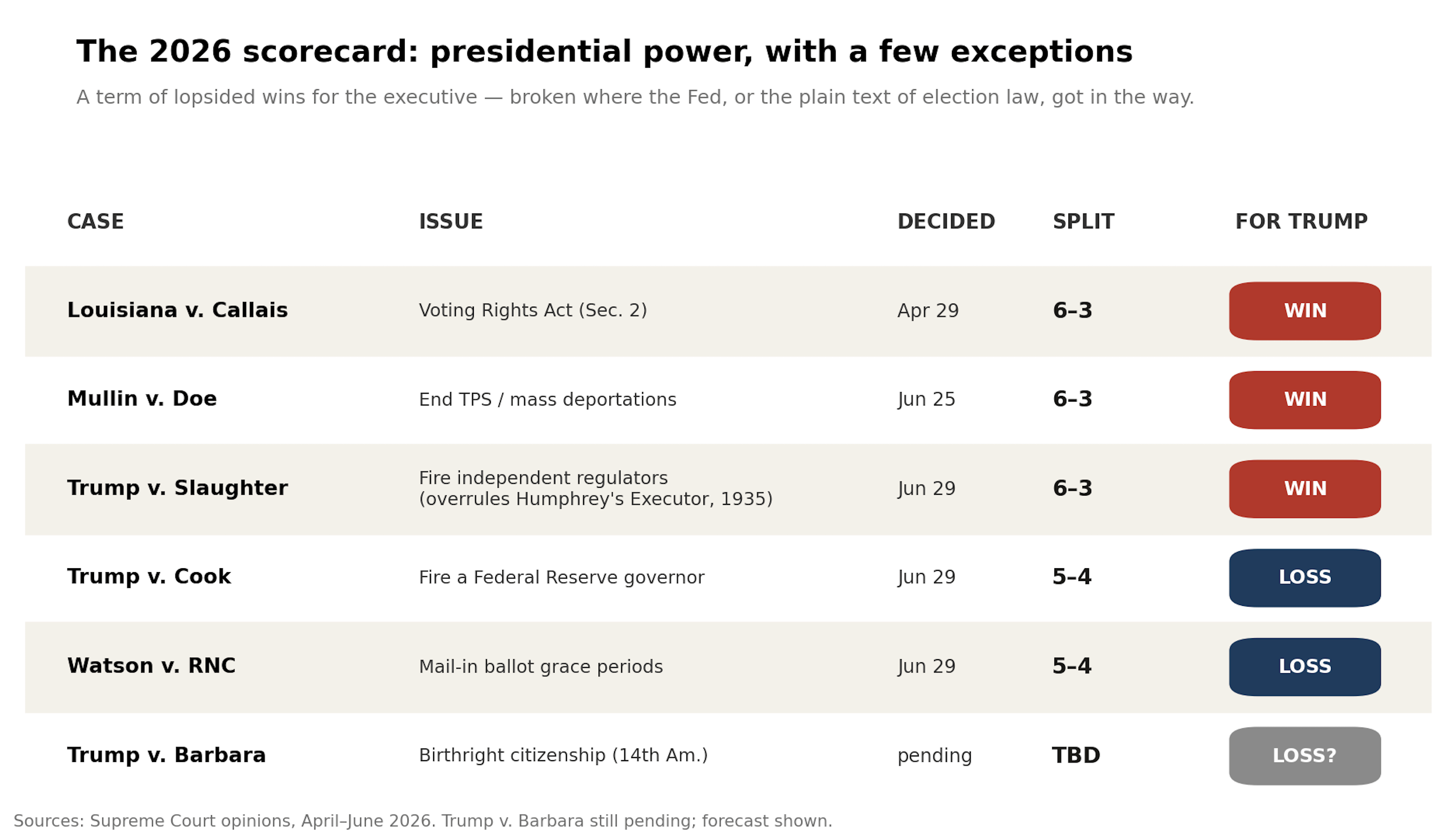
The Supreme Court closed its term the way a demolition crew closes a job site, and the building it brought down was ninety years old. In Trump v. Slaughter, handed down June 29, the six conservatives overruled Humphrey’s Executor, the 1935 decision that had allowed Congress to shield independent agencies from a president’s whims. Chief Justice Roberts, writing for the majority, was almost taunting about it: whatever survived of the old precedent, he wrote, the Court was now finishing off. The practical effect is that the president may fire the commissioners of the Federal Trade Commission, and bodies like it, for any reason or none. Justice Sotomayor read her dissent aloud from the bench, a gesture reserved for alarm, and warned that the president had been handed authority an English king would have envied.
The ruling did not arrive alone: days earlier the Court had cleared the administration to wind down Temporary Protected Status for hundreds of thousands of people who had been living and working here legally for years. Two months before that, in Louisiana v. Callais, it had hollowed out what remained of Section 2 of the Voting Rights Act, and Southern legislatures had begun redrawing their maps before the ink dried. Taken together, the term reads as a sustained constitutional argument for presidential supremacy over the machinery of government.
And then, on the very same day it buried Humphrey’s Executor, it refused to let the president remove Lisa Cook from the Federal Reserve. The vote was just 5 to 4. Roberts and Justice Kavanaugh broke from the other four conservatives and joined the three liberals to protect her. The Fed, the majority explained, is a “uniquely structured, quasi-private entity” descending from the First and Second Banks of the United States, and therefore stands apart from the agencies the president had just been freed to purge.
On the same crowded final day, in Watson v. Republican National Committee, the Court upheld Mississippi’s practice of counting mail ballots that arrive within five days of an election so long as they are postmarked on time, turning back a challenge brought by the Republican National Committee. The opinion was written by Justice Barrett, joined by Roberts and the three liberals, and the president received it poorly, denouncing it online as a “tremendous loss” and renewing his demand for a national proof-of-citizenship voting law. Two 5-to-4 defeats in one afternoon, each built by a different pair of conservative defectors, show that this supermajority has seams.
The doctrine does not actually support the Fed exception. If the Constitution forbids insulating the FTC from the president’s will, the same logic should doom an insulated Federal Reserve, and the four dissenters in Cook — Thomas, Alito, Gorsuch, and Barrett — said precisely that, with the satisfaction of people who have caught the majority in an inconsistency. They are correct on the logic. The Fed carve-out is a consequentialist patch dressed as a principle. So the interesting question becomes what the real limiting principle is, the one the majority would not write down. What actually draws the line is the bond market.
Follow the reasoning the Court declined to make explicit. A president who can fire trade regulators and immigration officials reshapes policy. A president who can fire the people who set interest rates reshapes the value of the currency, the cost of every mortgage, and the credibility of the dollar as the world’s reserve asset. The first power rearranges the furniture; the second can burn the house down, and the smoke would reach the Court itself, whose legitimacy rests on operating inside a functioning economy. Central-bank independence is a young and largely extra-constitutional norm, a twentieth-century habit rather than a founding command. The conservative legal movement’s signature theory, the unitary executive, followed all the way to its terminus, would dismantle the one institution that underwrites the money. Confronted with that cliff, two of the six justices declined to walk off it, and dressed their hesitation in the robes of the First Bank of the United States.
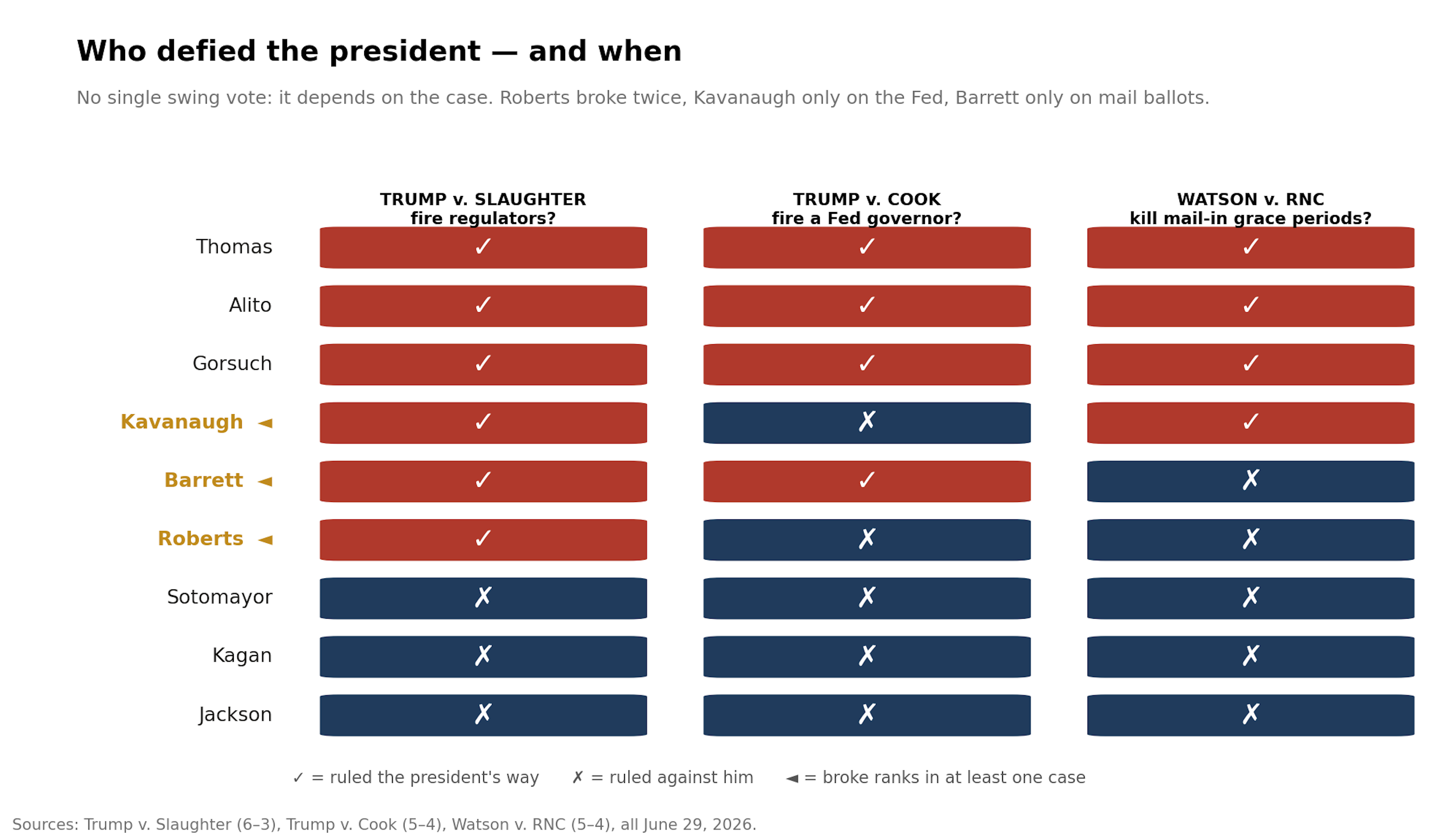
This is why the alignment chart matters more than any single holding. The conservative supermajority is there, and on the core project of expanding executive power it usually votes as one. The cracks open case by case, and they do not run along a single fault. Roberts is the steadiest defector, the institutionalist who crossed to shield both the Fed and the Mississippi mail ballot, guarding stability and the Court’s standing wherever he sees them under strain. Kavanaugh broke ranks only for the central bank and stayed with the wing on election law, which makes him the swing vote on executive power in particular. Barrett did the reverse: she would have let the president fire a Fed governor, yet she authored the opinion that denied him on mail-in ballots, a reminder that her textualism still sometimes outruns her partisanship. The tidy story of Barrett hardening into the hard wing now needs an asterisk. The three liberals, shut out of the blockbusters, salvaged two large victories, each handed to them by a different conservative who needed their votes to reach five. There is, in the end, no single median justice — there is a different swing for every kind of case, which is a far more useful thing to know than any neat 6-3 caricature.
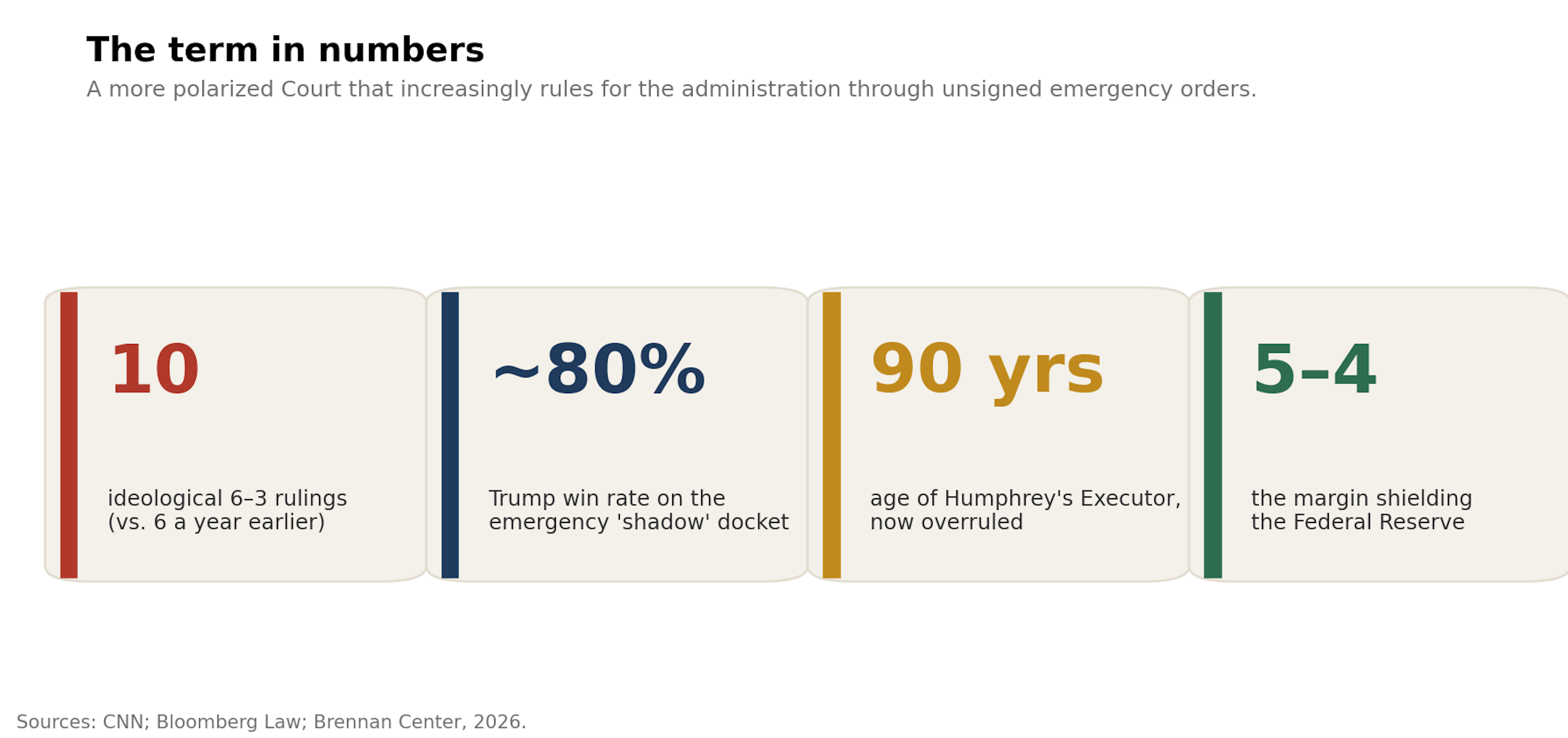
The Court produced ten ideological 6-3 decisions this term, against six the year before, and it sided with the administration in roughly 80 percent of the emergency-docket applications that now arrive in a steady stream, most resolved by terse midnight orders with little explanation. Government by shadow docket has become the house style.
So what comes next? The most immediate test is birthright citizenship. In Trump v. Barbara, argued in the spring and due any day, the administration is asking the Court to read the Fourteenth Amendment’s Citizenship Clause as something narrower than a century of practice has assumed. At argument a majority appeared unwilling to go along, and the forecast here is that the executive order falls, perhaps by a margin wider than the removal cases produced, because the amendment’s text is too explicit for even committed originalists to finesse. That outcome would confirm the term’s real rule, the one Watson just illustrated: this Court will hold the line where the text, statutory or constitutional, is unambiguous, and defer to the president almost everywhere else. The defiance is applied only where the words leave no room to maneuver.
Beyond that, the removal revolution will roll downhill. With Humphrey’s Executor gone, expect the administration to clean house at the National Labor Relations Board, the Federal Election Commission, and every other body that mistook its independence for a guarantee, and expect the Court to wave most of it through. Agency autonomy is finished, the Fed excepted — and that fortress is thinner than it looks, a 5-4 wall resting on two men. A future case will test whether the shield covers the Fed’s bank-supervision arm or only the core act of setting rates; my wager is the latter. Because the exception survives on a single vote, the surest way to topple it is a vacancy, which means the next confirmation battle will double as a fight over who controls monetary policy — a detail markets will price long before the Senate votes.
The biggest lesson of the term is that this Court has arrived at a theory of presidential power with exactly one footnote, and the footnote is written in the language of finance. The justices will let the president remake the government down to the studs, provided he keeps his hands off the single institution the global economy is priced around. Sotomayor warned that the Court had crowned a king. The majority answered, without quite admitting it, that even a king must leave the central bank alone — the most revealing thing the Court said all year.
See ya, folks. Stay curious!
—J&E