

F**k you, Wemby!
The first in a three part series on the New York Knicks
ABOUT THIS SERIES
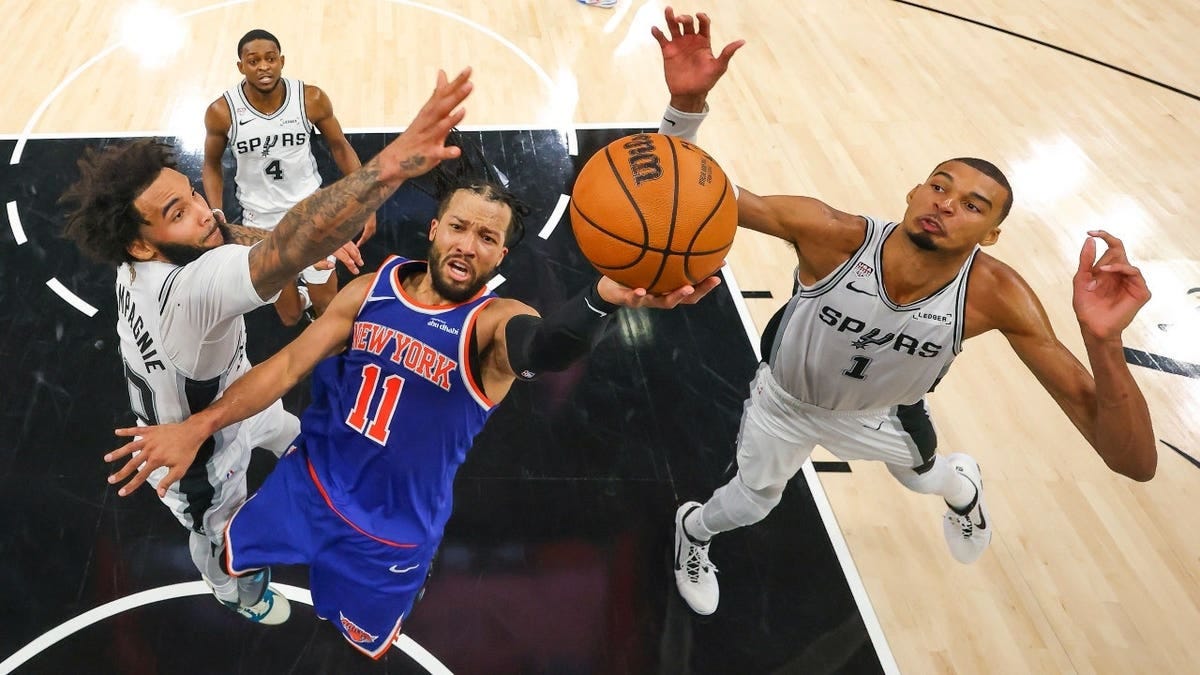
The 2026 NBA Finals — Knicks vs. Spurs, tied together since they last met here in 1999 — is the best live case study in sports economics we’ve ever had. One franchise is a publicly traded New York institution trading at a multibillion-dollar discount to its own private value. The other is a small-market team whose entire financial future runs through a single 7’4” balance-sheet asset from Le Chesnay, France. Over three issues, we’re using this series to explain how the modern sports economy actually works:
Part I (today): The Dolan Discount. Why the Knicks are worth $9.85 billion, lose money, and just became a Wall Street darling anyway — and what the proposed MSG Sports spinoff is really designed to do.
Part II: The Wembanyama Arbitrage. How the Spurs turned a $16.9 million salary into the most valuable contract in professional sports, why small-market economics depend on the rookie scale, and what a $1.3 billion arena fight tells us about public subsidy math.
Part III: The $76 Billion River. The media-rights deal that floats every boat — how national TV money sets the salary cap, why franchise values compound faster than the S&P, and whether any of this is sustainable.
Parts II and III will run exclusively for PTT Pro subscribers. If someone forwarded you this issue, subscribe here to catch the rest of the series — $150/year, written for people who read footnotes.
Two Scoreboards
On Monday night at Madison Square Garden, in front of a courtside row that included the sitting President of the United States, the San Antonio Spurs beat the New York Knicks 115–111, snapping the Knicks’ thirteen-game playoff winning streak — the second-longest single-postseason run in NBA history. The Knicks still lead the Finals 2–1. Game 4 is tonight, back at the Garden.
That’s the scoreboard everyone watched. Here’s the one we care about: over the past twelve months, James Dolan’s three public companies, MSG Sports, MSG Entertainment, and Sphere Entertainment, have risen an average of 152%. MSG Sports stock hit an all-time high in late May, the day the Knicks clinched their first Finals berth in 27 years, pushing the company’s market value past $8.8 billion. For a stock that went essentially nowhere for the seven years through mid-2025, that’s pretty significant.
This issue is about what got repriced, and why it took so long. The answer involves a money-losing duopoly of beloved teams, two record-setting private sales 3,000 miles apart, an SEC filing, and the oldest pattern in sports finance: public markets ignore these assets until someone threatens to sell one.
The Asset: A $13.5 Billion Company That Loses Money
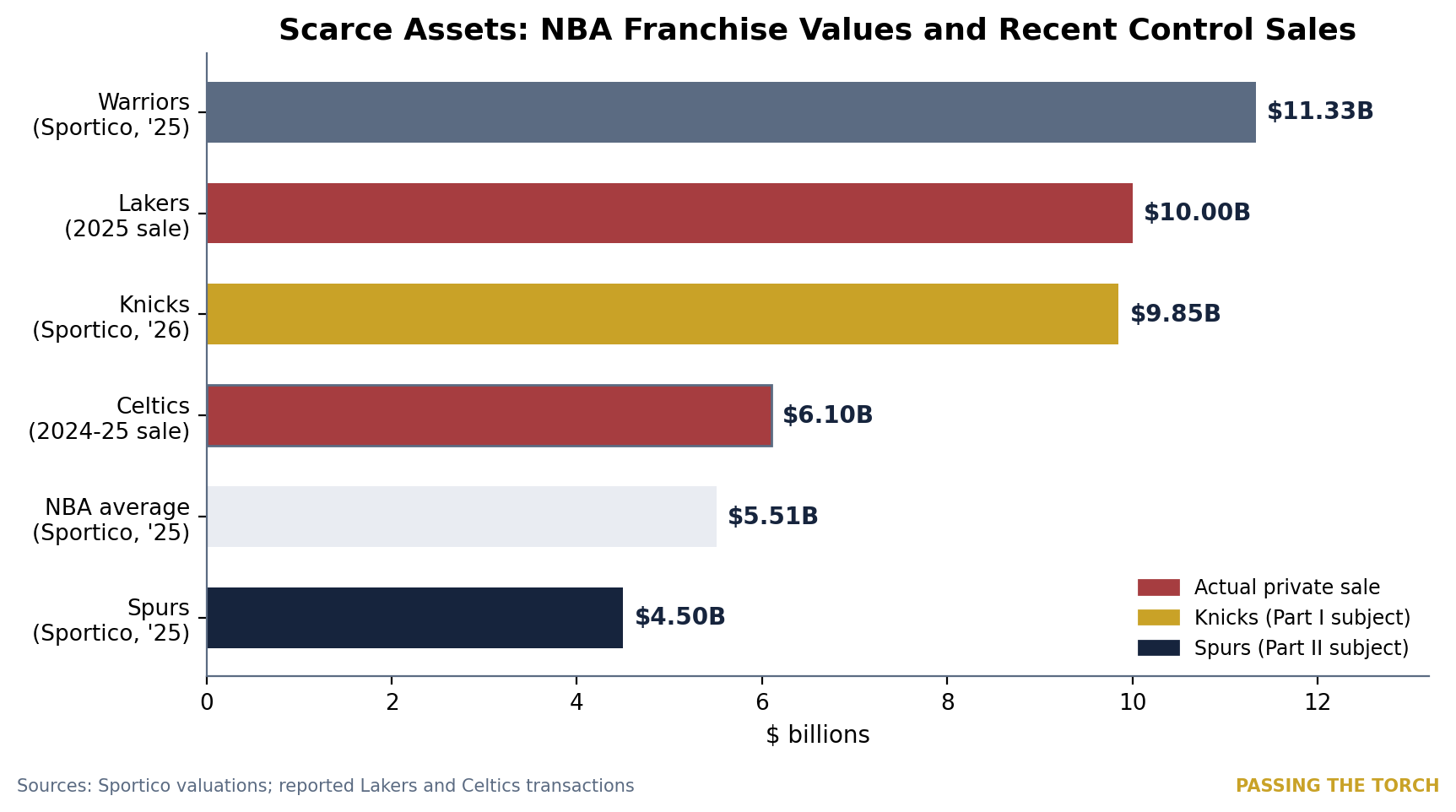
MSG Sports (NYSE: MSGS) owns exactly two things that matter: the New York Knicks, which Sportico values at $9.85 billion (third-most valuable franchise in the NBA) and the New York Rangers, second-most valuable team in the NHL at $3.65 billion. Combined private-market value: $13.5 billion.
Now the part that breaks the brain of anyone trained on discounted cash flows: in fiscal 2024–25, a year in which the Knicks reached the Eastern Conference finals, the two teams lost a combined $22 million after taxes and interest. In the most recent quarter, MSGS posted $432.2 million in revenue, up a whole 1.9%, and a $20 million net loss, wider than the year before. Analysts forecast roughly flat revenue for the next three years. On every metric you’d apply to a normal media company, this is a mediocre business with a great brand.
The resolution to the paradox is that teams are not valued as businesses. Chris Marangi, CIO of Value at Gabelli Funds, whose sports ETF counts MSGS as its largest holding, has argued that sports franchises don’t trade on earnings or free cash flow at all; they behave like gold: scarce stores of value that have to be understood on those terms. There are thirty NBA teams. There is one that plays in Manhattan. The cash flow statement is almost beside the point. What you’re buying is a permanent seat at the table of American culture, with a supply curve that is a vertical line.
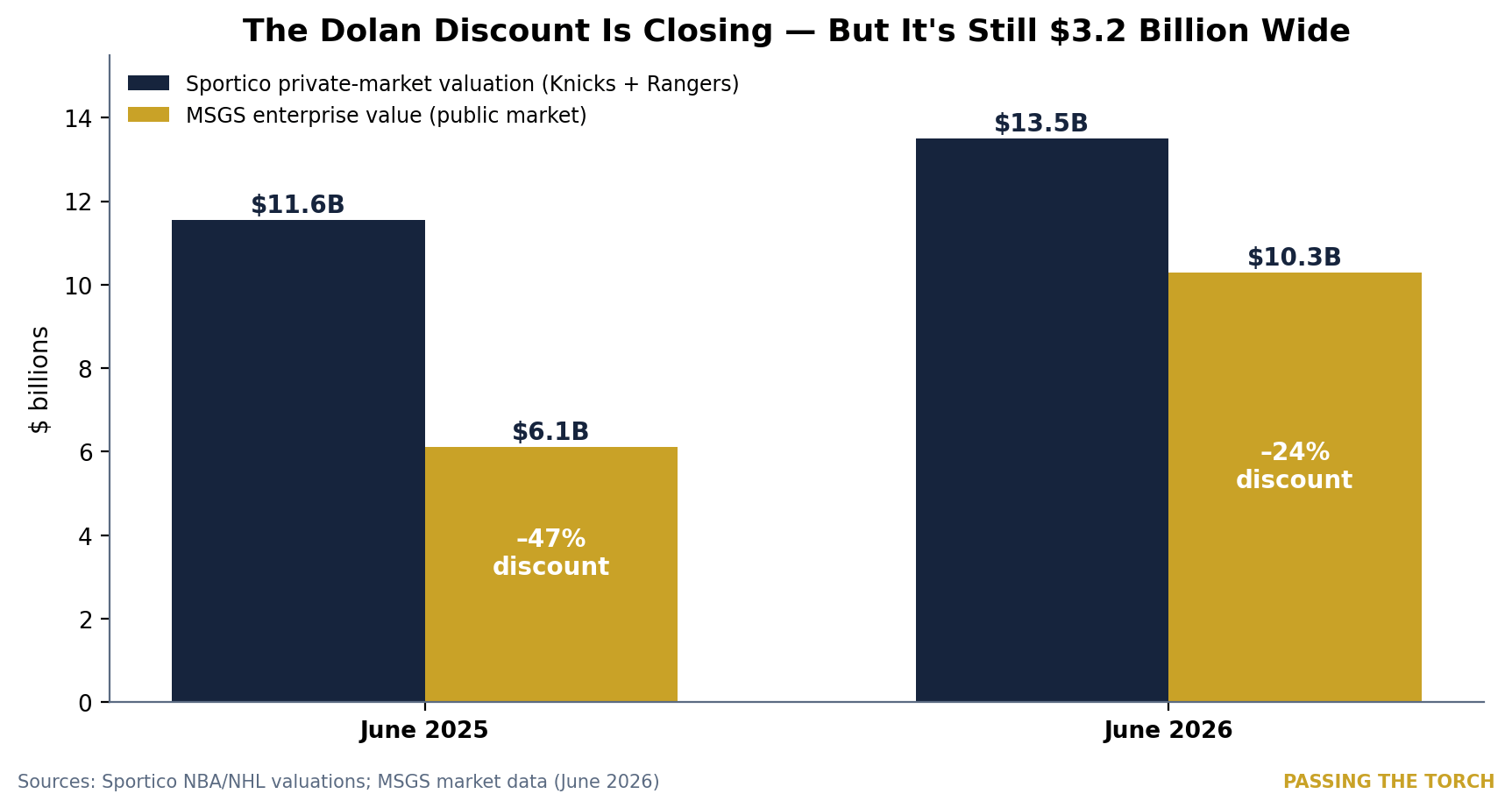
For decades, there was a running joke among sports investors that MSGS traded at a massive discount to the underlying value of the private teams it held due to something called the, “Dolan Discount.” This is, of course, a reference to the Dolan Family, the owners of MSGS. A year ago, MSGS was trading with an enterprise value a full 47% below the Sportico then valuation of $11.55 billion. You could have, in theory, bought the two teams, the Rangers and the Knicks, for a near 50% off discount in the public markets relative to what a private sale would have fetched. Of course, that wouldn’t have been possible because the Dolan family which has a controlling stake showed no signs of selling.
Then came the change catalysts: (1) the comps — Boston’s Celtics sold at $6.1 billion. Last year, Mark Walter agreed to buy the Los Angeles Lakes at $10 billion. Private sales allow for a paper valuation to become legitimate. (2) the structure — In February, MSG Sports’ board approved a plan to spin the Rangers off from the Knicks, creating two separate publicly traded companies. The stock then jumped 16% on the day of the announcement. In May, the company filed a Form 10 registration statement with the SEC moving from exploration to paperwork. The value unlock was simple: the conglomerate discount effect was being applied to the grouped ownership of the two teams. With a pure play on the Knicks, investors could more accurately apply the Lakers comp and take part in a franchise that there was far more interest in. (3) the team got good — Playoff home games at the Garden generate roughly $7 million operating profit apiece. This far exceeds regular season economics. The Knicks have now hosted multiple deep playoff runs in consecutive seasons; this is tremendously profitable. They won the NBA Cup in December. More importantly than anything, they have the most loyal, dedicated, and earnest fanbase in all of NBA basketball.
The best way to frame MSGS is actually very simple, it’s just a little counterintuitive. Similar to a Korean holdco, a closed-end fund, or even a collection of real estate assets, you aren’t actually buying MSGS for the earnings. Earnings are flat to negative and they are forecast to remain that way. You’re buying a series of events, probability weighted, with exit value: (1) the spinoff is successful, (2) the pure-play Knicks continue to perform well and rerate to private market valuation, and (3) eventually, the Dolan family indicates willingness to sell. The Cleveland Indians traded below their IPO for years before the sale; Manchester United stayed under $13 per share and then more than doubled the moment the Glazers hired bankers to explore sale options. If liquidity exists, the market prices the team to its real value.
That doesn’t mean there isn’t a bear case here. The discount has already tightened by half, meaning there is far less easy money to be made. The remaining 24% gap might just be the price of owning as a minority stakeholder under a controlling family that has repeatedly burned their shareholders. The spinoff has no committed timeline, requires league approval, and could stall. A stock that has gained 89% YTD purely on the basis of exit aspirations has much exposure to that same exit being deferred in time and the price rerating downwards to a more patient valuation. If you bought in June 2025, you were getting lucky for seeing around the bend; if you buy today, you’re really depending on an action relatively soon.
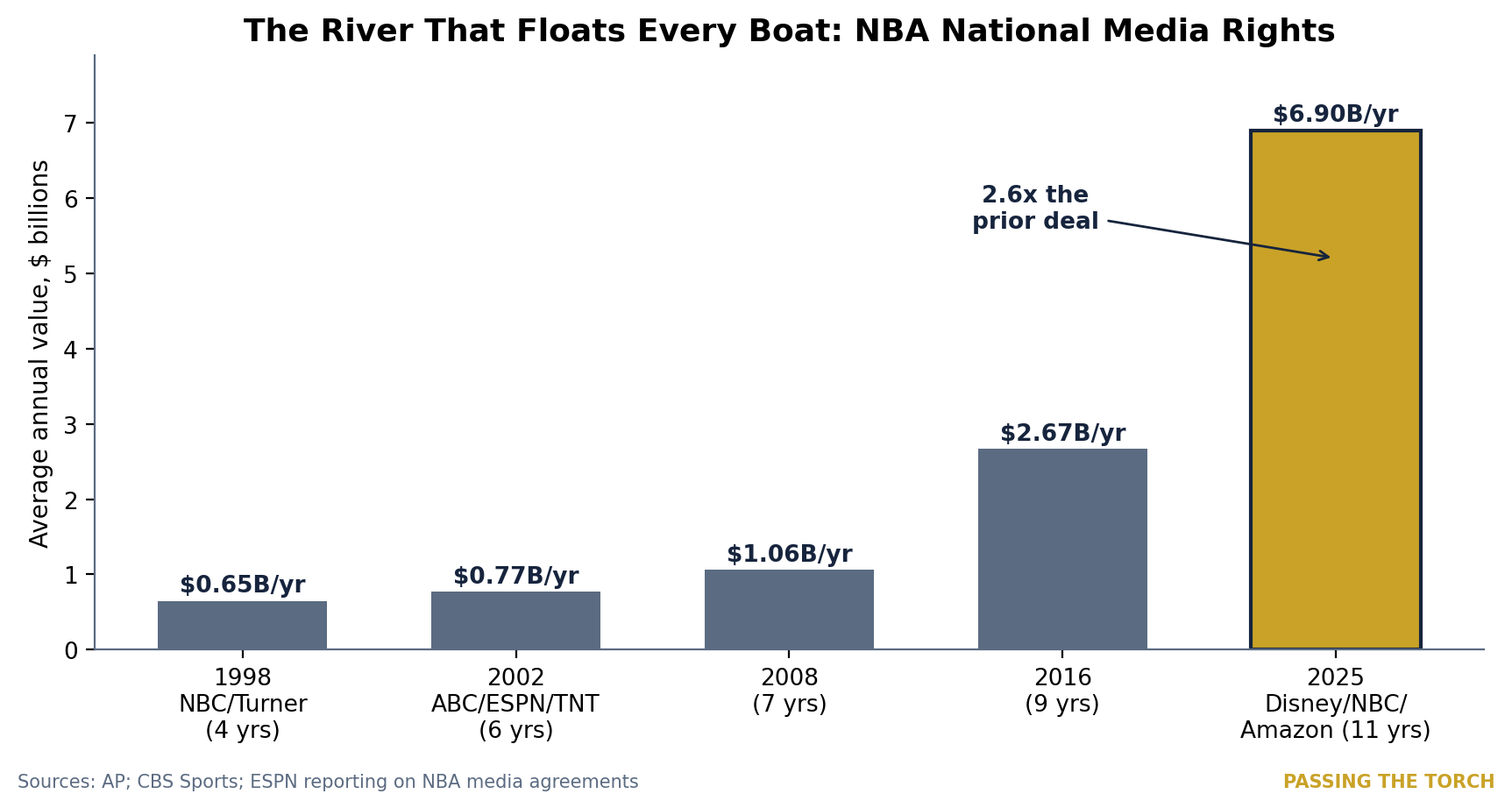
Whether you are long or short here, you can’t dispute the directionality of teams in the league. New media agreements with Disney, NBCUniversal, and Amazon (eleven years, a reported $76 billion, 2.6x annual value of the prior deal) began flowing this season, and every team’s valuation sits at the bottom of that river. We will spend all of Part III in this series on that. Subscribe to Pro to access it when it’s released!
Tonight at the Garden, every Knicks win at home is worth roughly $7 million in direct operating profit and plenty more in narrative value. The one thing that moves a trophy asset’s price more than anything is simple: trophies. Meanwhile, the opposite side of the Knicks bench is essentially the opposite in all regards. The Spurs are small market, private, and much lower price tag — but they very well may own the most valuable contract in all of sports: Victor Wembanyama, paid $16.9 million next season under the rookie scale, projected to sign a five-year extension north of $300 million the moment his window opens on July 1, three weeks after the end of the finals series. The gap between what Wemby is paid and what he’s worth is perhaps the most important spread in all of sports finance.
Part II, the Wembanyama Arbitrage, arrives tomorrow morning for PTT Pro subscribers. Subscribe for Pro below, for just $15/month, and get the next article directly to your inbox.
Thanks for reading folks and as always, stay curious!
—J&E