

Going Dark, Optionally
The SEC is about to let companies report earnings twice a year instead of four times. The whole thing will be settled by who chooses to switch off the lights.
A Revolution in a Cardigan
In May, Paul Atkins’s SEC proposed letting American public companies file a new twice-yearly report, Form 10-S, in place of the quarterly 10-Q, and most people expect the rule to be finalized before year-end. President Trump has pushed it hard, arguing that “quarterly” reporting chains executives to the next thirteen weeks. The pitch is a liberation story: free the long-term thinker from the treadmill.
Look closer and the proposal is more modest, and more interesting. It is optional. A company can switch to semiannual reporting or keep filing quarterly, whichever it prefers. So this is a simple menu change sold as a radical manifesto — a small deregulation dressed up as a complete revolution.
The philosophical case is probably the weakest part of the whole thing. The main claim is that quarterly reporting breeds short-termism: managers starve long-term investment to hit a near-term number. It is an intuitive idea, and the evidence for it is thin. Britain ran the experiment for us, in both directions. It required quarterly reporting in 2007 and dropped the requirement in 2014, and when economists looked for the promised effect on corporate investment, they found essentially nothing — no meaningful fall when quarterly was imposed, no meaningful rise when it was lifted.
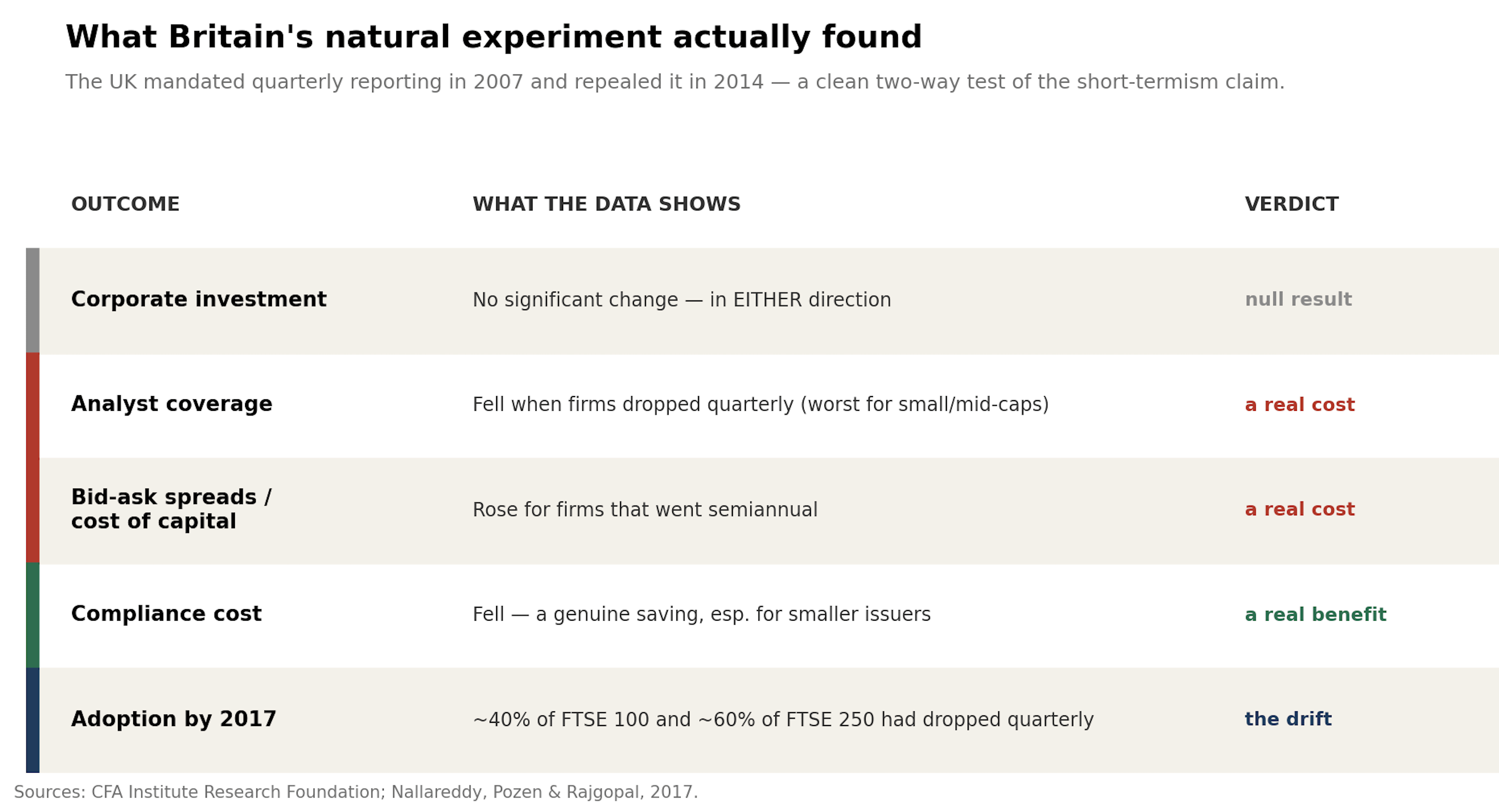
A few studies do find modest short-term effects from more frequent reporting, which is why reasonable people still disagree; but the cleanest natural experiment we have points at roughly zero. Short-termism is driven by executive pay tied to the share price, by activist investors, and above all by earnings guidance — the quarterly forecast game. Even Warren Buffett and Jamie Dimon, the loudest voices for this cause, aimed their 2018 op-ed at guidance, not at the reports, a distinction the current proposal glosses over. You can abolish the 10-Q and leave every real driver of short-termism running.
So the headline argument is mostly a fib. The unglamorous one underneath it is real. Quarterly reporting carries a genuine cost — auditor reviews, legal sign-offs, disclosure committees, the whole compliance process — and that cost falls hardest on small-cap and young companies, for which it is a real tax on being public at all. Relief there is a fair goal, and it is the true, boring point of the reform: a targeted break on the small-cap disclosure bill. That is a defensible thing to want, and a much less thrilling thing to announce.
Two Cartoons
To feel the trade-off, it helps to run two stories to their extremes — with the obvious warning that reality never behaves this cleanly. Most firms sit in the dull middle, and the real effects are small, varied, and highly dependent on the people involved. These are purposefully binary cartoons, drawn to make the trade-off visible.
Cartoon one, where it goes right. Emile Tooling Inc. is a $400-million industrial firm spending three years on a new plant. Quarterly compliance costs it a couple of million dollars a year and a permanently stressed finance team, and analysts pester it every spring about a capital line that won’t pay off until the plant opens. Emile Tooling switches to semiannual, banks the savings, reinvests them, and stops reporting a long project in ninety-day chunks. Three years later the plant is running, the analysts who stayed had the whole thesis anyway, the bid-ask spread widened a little, and no one was hurt. The reform did exactly what it promised.
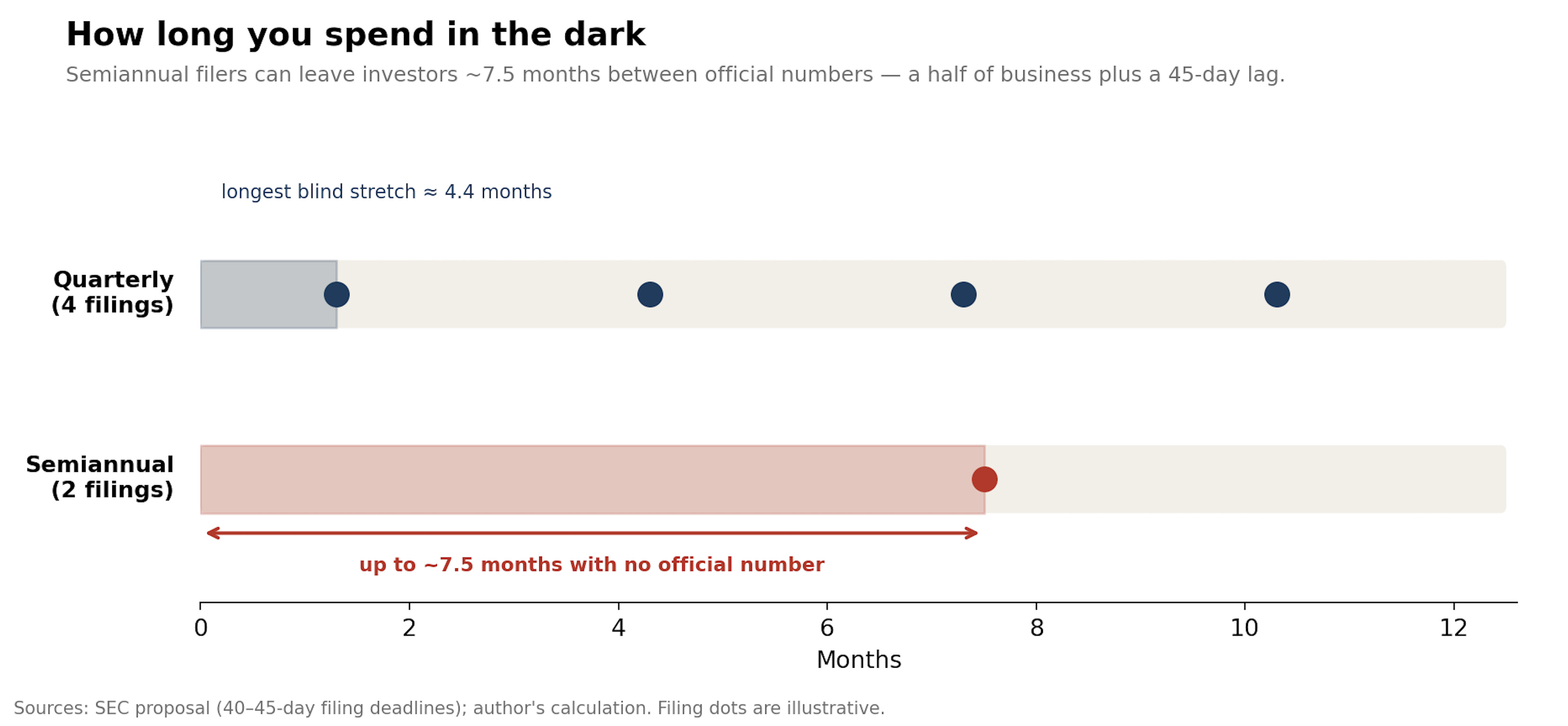
Cartoon two, where it goes wrong. Jasper Credit Corp. is a mid-cap specialty lender whose loan book has started to go bad. It switches to semiannual. For nearly seven months — a half-year of business plus the 45-day filing lag — there is no official number, and a quarterly would have flagged the rising delinquencies management can already see on its internal dashboards. During that dark window, a few insiders trim their positions. When the semiannual finally lands, it is a bloodbath: the stock halves in a day, and the retail holders who had no way to see inside are the ones left holding it. A Wirecard, in slow motion, with the lights turned down.
The honest point is that the same rule produced both endings, and the thing that decided which one you got was never the SEC. It was whether the people running the company were building a plant or hiding a hole. Quarterly reporting is one of the tripwires that catches the second kind before the damage grows, and the reform pulls up a tripwire in the name of the first.
Who Turns Off the Lights
“Optional” is the most important word in the document. Because the switch is a choice, the choice itself becomes key information.
Consider what a large, healthy company gives up by going dark: analyst coverage, which the UK data shows reliably falls when firms drop quarterly, and with it price efficiency, tighter spreads, and a lower cost of capital. A blue-chip with nothing to hide has little reason to accept that penalty. A firm that would rather you not look too closely has every reason. This is the oldest dynamic in the disclosure literature, the one George Akerlof described with used cars: when hiding is optional, the choice to hide becomes a signal, and the market learns to price it. Over time, going semiannual could pick up the same stigma that dropping earnings guidance already carries — a hint that there is less to show, or more to bury.
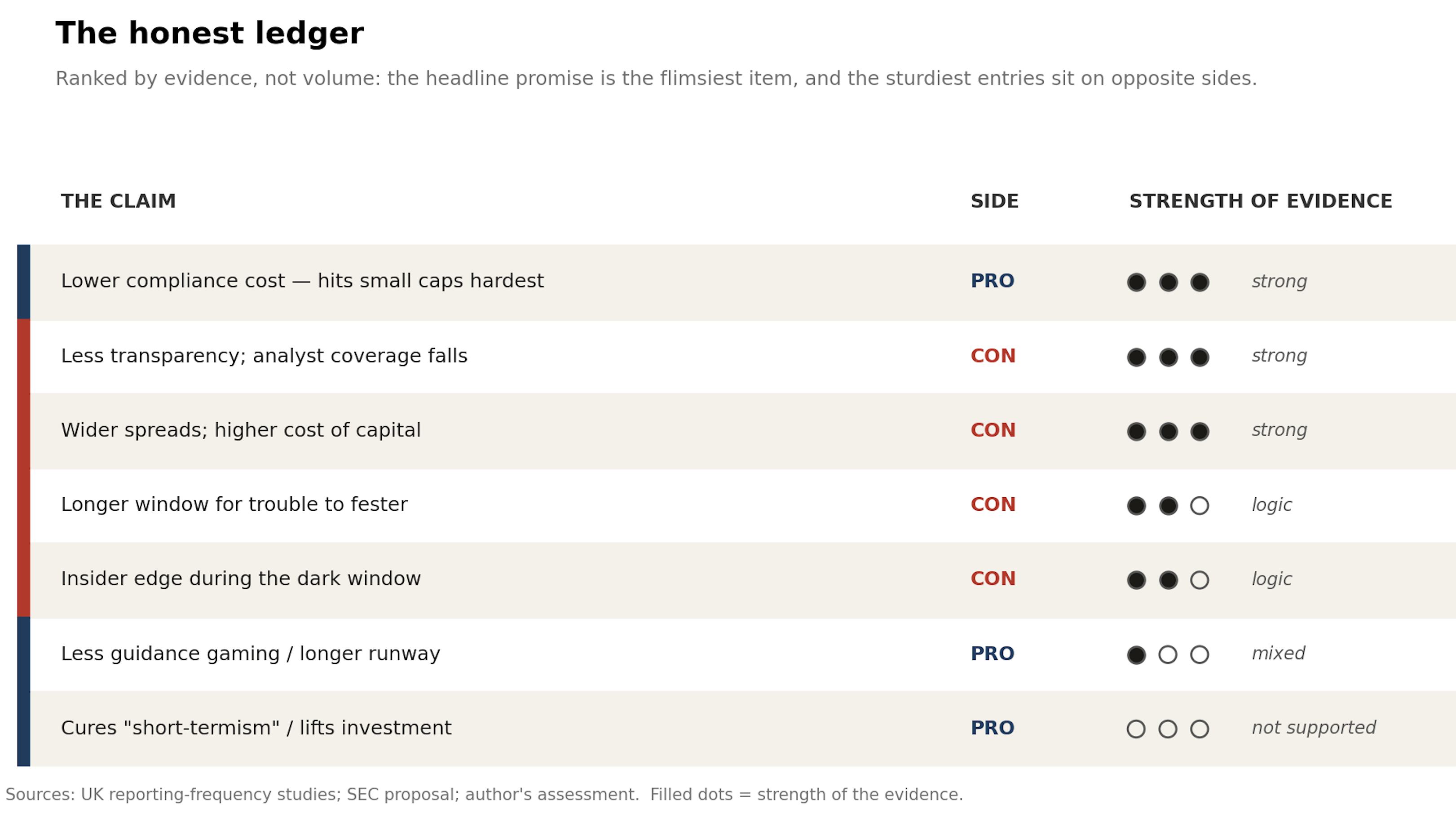
If that holds, the reform will sort companies into two visible groups: a transparent tier that keeps filing four times a year to prove it has nothing to fear, and a trust-me tier that goes dark and pays for it in a higher cost of capital. The blue chips mostly stay put, the small caps get their cost relief, and a long tail of ambiguous and opaque firms drifts into a middle ground where the honest save money and the dishonest buy time. Britain’s own adoption curve points this way: barely a tenth of firms dropped quarterly in year one, but within three years roughly forty percent of the FTSE 100 and sixty percent of the smaller FTSE 250 had, the demand concentrated exactly where analyst coverage was already thinnest.
So, my verdict, for whatever it is worth on a rule this deliberately dull. The reform is defensible and oversold — a real, modest gift to small-cap issuers, justified by a short-termism story the evidence does not support, bought at the price of a real, modest increase in opacity that will land hardest on the investors least able to work around it. The real risk arrives the day “optional” becomes “expected,” and the companies you would most want to watch realize they can just turn the lights down, on a schedule, and dare you to guess what moved in the dark.
See ya, folks. Stay curious…
J&E (Founders of Emile Tooling Inc. and Jasper Credit Corp.)